Forty-eight years ago today — November 8, 1978 — the first Canadair Challenger lifted off from Montreal. It began life as the LearStar 600, a business jet design by Bill Lear, who sold the rights to Canadair. Canadair renamed it the CL-600 Challenger, and a Canadian aviation success story was born — one that still flies today in both civilian and military colours.
The civilian Challenger
The Challenger was a clean-sheet design: a low-wing jet with two turbofans in pods on the rear fuselage, a supercritical wing, and a stand-up cabin — roomy for a business jet of its day. The original CL-600 flew on Lycoming ALF 502 engines (81 built). The CL-601 added winglets and more powerful General Electric CF34 engines. The CL-604 was a major upgrade — more powerful engines, more fuel, a new undercarriage and a modern Collins ProLine 4 cockpit — followed by the CL-605 and today’s CL-650. The 1,000th Challenger was delivered in December 2015, to NetJets. The design proved so sound it was stretched into the Bombardier CRJ regional airliner and developed into the long-range Global Express.
The road wasn’t without loss: the first prototype was lost in a deep-stall test accident in the Mojave Desert on April 3, 1980, killing one of the test pilots. Transport Canada certified the type on August 10, 1980, and in 1986 Canadair was bought by Bombardier.
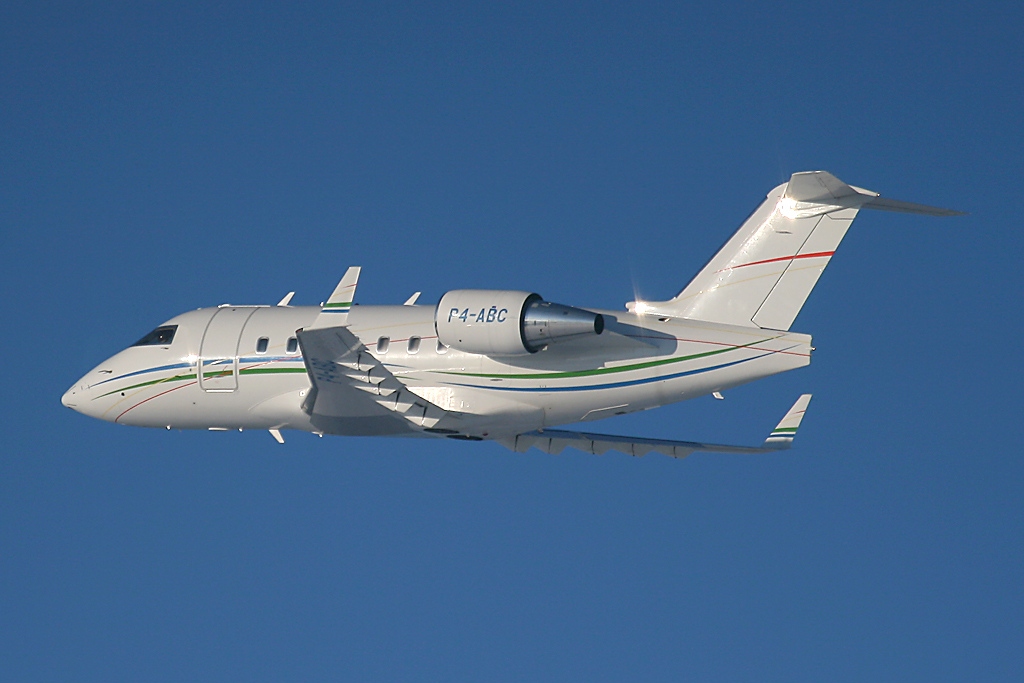
A civilian Bombardier Challenger 604 in flight. (Photo via Wikimedia Commons, GFDL 1.2)
The military CC-144
Canada bought 12 Challengers for the Canadian Forces, designated CC-144 (with CE-144 for electronic warfare and CX-144 for the second prototype, which joined the RCAF after testing). The first came on strength in April 1983 with 412 (Transport) Squadron at CFB Ottawa (Uplands). Its main job ever since has been VIP transport — flying the Governor General, the Prime Minister, members of cabinet, and visiting royalty, including Queen Elizabeth II, the Duke of Edinburgh, and the Prince and Princess of Wales. The fleet has also done electronic warfare work with 434 Squadron at Greenwood, Nova Scotia (1995–2000) and medevac, with the cabin furniture swapped for stretchers. The fleet was cut from six aircraft to four in 2014. Today four Challengers — two 604s and two 650s — fly with 412 Squadron out of Ottawa, owned by 8 Wing Trenton, with one permanently configured for VIP work. The first of the fleet, CC-144601, retired in 2014 and is now on display at the National Air Force Museum of Canada in Trenton. Canada isn’t the only military operator: the United States Coast Guard flies a single Challenger 604 as the C-143A, its Medium Range Command and Control aircraft since December 2005. And the CC-144’s days are numbered — in December 2025 Canada announced six new Bombardier Global 6500s to replace them, with first deliveries expected in the summer of 2027.
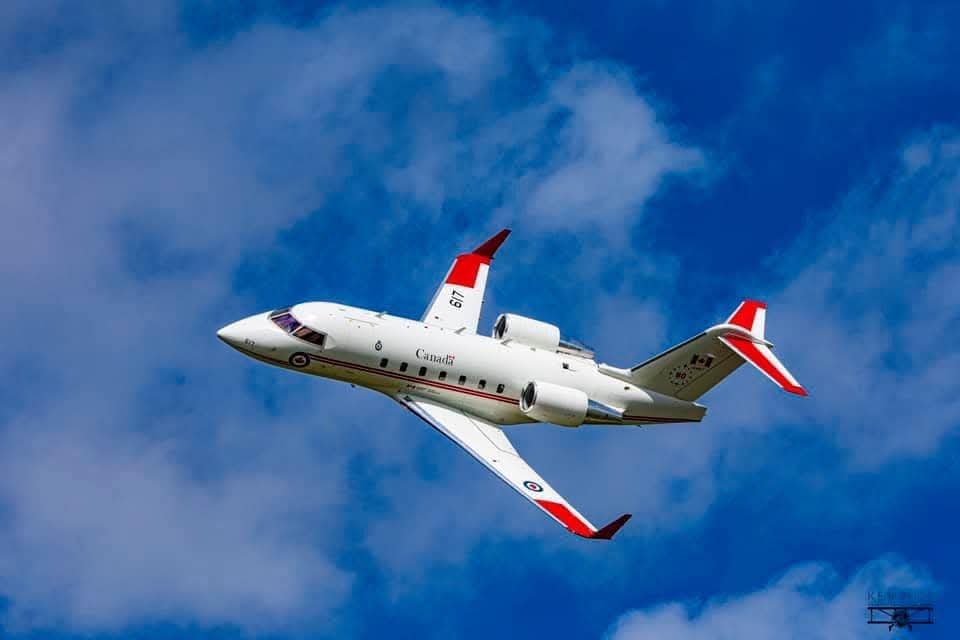
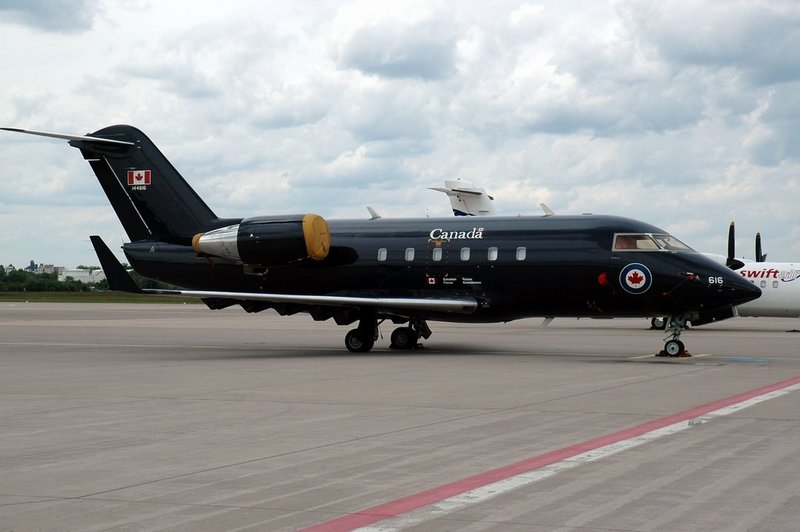
A CC-144 Challenger (144619) in flight. (Photo: Ken Mist)A Canadian Forces CC-144 Challenger, VIP transport for the Prime Minister and Governor General. (Photo via Wikimedia Commons, CC BY-SA 3.0)
Sources: Wikipedia — Bombardier Challenger 600 series; National Air Force Museum of Canada — CC-144 Challenger; 412 Transport Squadron; List of active Canadian military aircraft.
Woodstock, Ontario, produced a remarkable concentration of airmen for a city of its size — and one of the most important airmen in Canadian history. At least eight men with a solid Woodstock connection served as RCAF pilots in the Second World War, and seven of the eight were killed. The eighth was a First World War ace who went on to become one of the RCAF’s senior commanders. This is their story — and the story of the Woodstock men named on the city’s cenotaph, and of a Woodstock pilot lost in our own time.
Air Marshal George Owen Johnson
George Owen Johnson was born in Woodstock on 24 January 1896, and died in Vancouver, BC, on 28 March 1980, aged 84. He served in the Royal Flying Corps, with No. 84 Squadron and No. 24 Squadron RAF, flying S.E.5 fighters on the Western Front in 1917–18. He was credited with 11 aerial victories, and was awarded the Military Cross in April 1918 and the French Croix de Guerre. He was one of the first officers of the RCAF after the war, and flew in the first trans-Canada flight in 1920.
In the Second World War, Johnson was Deputy Chief of the Air Staff, and then Air Officer Commanding No. 1 Training Command from July 1942 — the command running British Commonwealth Air Training Plan training in southern Ontario. He was Air Officer Commanding Eastern Air Command from January 1943, during the Battle of the Atlantic. He was promoted Air Marshal on 25 March 1945, and was Air Officer Commanding-in-Chief RCAF Overseas until July 1946. He was made a Companion of the Order of the Bath, and received the US Legion of Merit (Commander) and the French Légion d’honneur (Commandeur). He retired in 1947. As Deputy Chief of the Air Staff he had been responsible for planning and building the BCATP station network — the direct link between Woodstock and the BCATP, though there was no BCATP station in Woodstock itself.
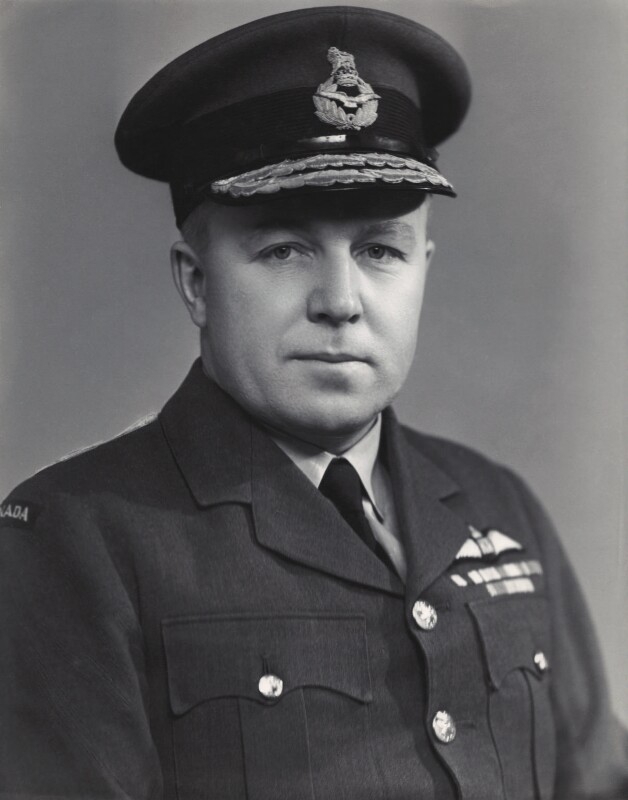
Air Marshal George Owen Johnson, born in Woodstock in 1896 — WWI ace with 11 victories. (Bassano Ltd portrait, via Wikimedia Commons)
Seven pilots who did not come home
Sergeant John Maxwell “Jack” Osborne, R/68081. Born in Woodstock on 24 August 1914, Osborne was educated at East Zorra public school and Woodstock Collegiate Institute, and worked in the city as a Firestone machine operator from 1935 to 1939 and as an attendant at Woodstock Hospital. He enlisted in the RCAF in June 1940, trained at Saskatoon, and earned his pilot’s wings in February 1941. He was posted to No. 226 Squadron RAF on 1 August 1941. He was killed in action on 10 August 1941, aged 26, shot down in flames by a Me 109 while attacking a ship off Calais during a “Circus” daylight raid, flying a Bristol Blenheim IV Z7280 — just nine days after joining his operational squadron. His observer, Sgt K. A. McManus, and wireless operator/air gunner FS Wynne Roberts were also killed. Osborne’s body washed ashore on Juist, in the Frisian Islands, on 17 August 1941. He is buried in Sage War Cemetery, Germany.
Pilot Officer Thomas Best, J/7030. Best was born on 1 February 1918 in Yorkshire, England. His home was in Woodstock, and his wife, Thelma Elizabeth Best, was of Woodstock. He served with No. 214 (Bomber) Squadron RAF at RAF Stradishall. He was killed in action on 2 April 1942, when his aircraft was shot down by flak over the target and crashed at Niederkassel-Lülsdorf, Germany. The type of aircraft he was flying was not confirmed in the sources consulted.
Flight Lieutenant William Wallace Murray, J/3703. Murray was a fighter pilot with No. 416 Squadron RCAF, flying Spitfires, and was a flight commander. He was quoted in Scotland in May 1942 after a cannon-firing test and a brush with a Me 109 over France in which he lost a wingtip. He was killed on 27 June 1942, aged 27; the circumstances of his death were not established in the sources consulted. His Woodstock link rests on a contemporary press report of May 1942 describing him as “of Woodstock, Ont.” and on the name “MURRAY, W.W.” on the Woodstock Cenotaph. His Commonwealth War Graves Commission record names his parents, William Wallace and Bessie Ann Murray, but no town — so the Woodstock connection should be treated as probable rather than fully proven.
Pilot Officer William Stanley Heal, J/35334. Heal was born on 31 October 1921, the son of William Cecil and Ethel Rich Heal, of Woodstock; the family farm was Lot 4, Concession 8, West Zorra. He served with No. 11 Advanced Flying Unit, flying the Airspeed Oxford X6874. He was killed on 20 February 1944, aged 22, when the Oxford stalled during a steep turn and crashed at Burland, Cheshire, England, during night-flying training. He is buried in Blacon Cemetery, Chester, England, Grave 990. His birthplace is disputed: the Canadian Virtual War Memorial gives Woodstock, while Heroes of Zorra says he was born in West Zorra Township, Oxford County.
Flight Lieutenant Stewart Kitchener Walker, J/12556. Walker was born on 3 March 1917, the son of Harold Guy and Clara Walker, of Woodstock, Ontario. He served with No. 122 Squadron RAF, an RCAF-manned fighter squadron, flying the North American Mustang FB110. He was killed in action on 15 August 1944, aged 27, on a fighter sweep near Chartres, France, last seen when the squadron broke to engage about 25 Me 109s and FW 190s. He is buried in Luray Communal Cemetery, Eure-et-Loir, France.
Flying Officer Jack Holtze, J85593. Holtze was born in Woodstock on 12 June 1917, the son of Adolph and Ethel Ruby Holtze (of London, Ontario). He served with No. 428 (Ghost) Squadron RCAF, No. 6 Group, Bomber Command, based at RAF Middleton St George, flying the Avro Lancaster X KB782. He was killed in action on the night of 2/3 November 1944, aged 27, on an operation to Düsseldorf; the Lancaster crashed at Solingen, Germany. Holtze, WO1 Leslie Ruhl and Sgt Joseph Bachant were killed in the crash. The four other crew members baled out and were murdered by German forces — a documented war crime. Holtze is buried in Reichswald Forest War Cemetery, Plot 1, Row F, Grave 12. His headstone reads: “Greater love hath no man than this, that a man lay down his life for his friends.”
Warrant Officer 1st Class Harold William Smith, R/131090. Smith was born in Woodstock on 4 May 1922, later living at 119 Oxford Street, Guelph. He worked as a Bank of Montreal clerk after leaving Guelph Collegiate, and enlisted in August 1941. He served with No. 229 Squadron, then No. 357 Squadron (Special Duties), Rangoon, Burma, flying the Douglas Dakota IV KN584. He was killed on 7 September 1945, aged 23, on a special-duties supply-drop operation near Mewaing, Burma — after VJ Day (15 August 1945). All four crew were killed. He is buried in Taukkyan War Cemetery, Myanmar (Special Memorial 13). He was an accomplished violinist, who won the Federation violin scholarship at the Stratford festival in 1937.
A modern-era loss: Capt. David Domagala
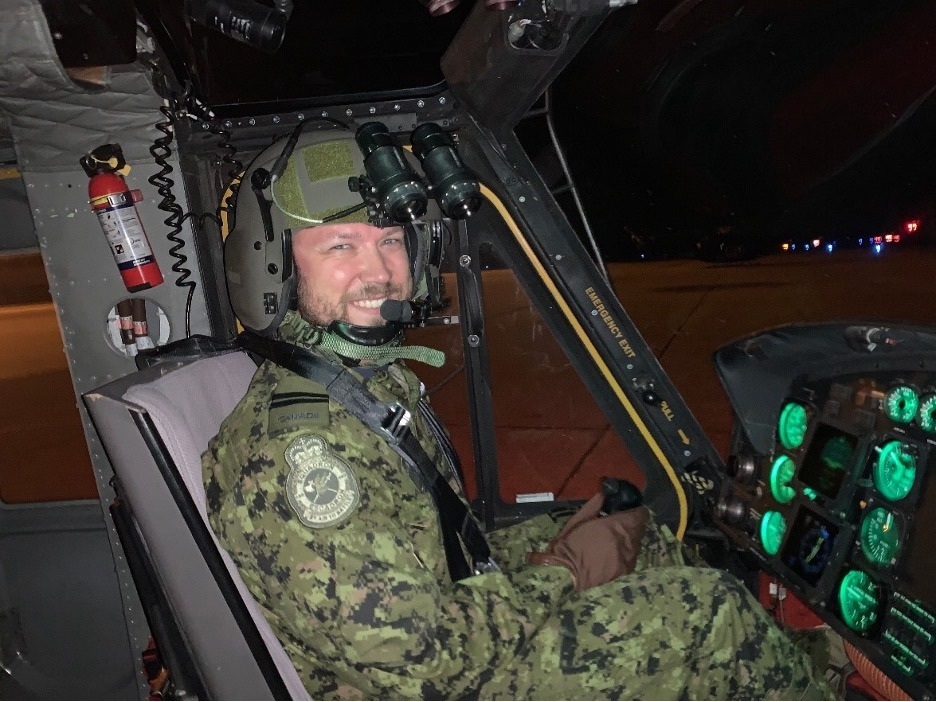
Capt. David Domagala was born in Woodstock, Ontario, on 22 August 1990, the son of Marek and Anna (née Fraczek) Domagala of Woodstock, husband of Shinea Kelly, and father of Leila and Lucas. He joined the Canadian Army Reserve in 2008, graduated from the Royal Military College in the Class of 2016, earned his wings in 2019, and was posted to 450 Tactical Helicopter Squadron, Garrison Petawawa, in 2019. He deployed as a liaison officer on Operation CALUMET in Egypt, and received a Commander Commendation from Canadian Joint Operations Command. He was training on the CH-147F Chinook.
He was killed on 20 June 2023, aged 32, when his Chinook crashed into the Ottawa River near Petawawa on a nighttime training flight. The other pilot killed was Capt. Marc Larouche, 53, of Amos, Quebec. Two other crew members survived with minor injuries. His visitation was held on 3 July 2023 at Brock & Visser Funeral Home, Woodstock, and his Funeral Mass with Military Honours on 4 July 2023 at Holy Trinity Church, Woodstock.
Capt. David Domagala in the cockpit at night. (Photo: Canadian Armed Forces)
The Woodstock Cenotaph roll
The Woodstock Cenotaph, on Graham and Buller Streets, was erected in 1925 and unveiled on 30 August 1925. It lists the Second World War dead in columns 7–9. It gives surnames and initials only, with no branch of service, so the RCAF aircrew on it were identified by cross-referencing the RCAF Association casualty lists, CASPIR and the Canadian Virtual War Memorial.
Six pilots are confirmed on the cenotaph: BEST, T.; HEAL, W.S.; MURRAY, W.W.; OSBORNE, J.M.; SMITH, H.W.; and WALKER, S.R. — spelled “S.R.” on the stone, though his name was Stewart Kitchener Walker.
Twelve more Woodstock men named on the cenotaph died as non-pilot RCAF aircrew — bomb aimers, navigators, air gunners and wireless operators. They were: AMOS, L.H. (bomb aimer, 431 Squadron, killed 25 April 1945); BEAUDOIN, C.H.M. (bomb aimer, 166 Squadron, killed 28 June 1944); CHILDS, A.J. (wireless operator/air gunner, 12 Squadron, killed 11 October 1941); DAFOE, J.S. (air gunner, 408 Squadron, killed 8 May 1942); EDWARDS, C.S.R. (air gunner, 115 Squadron, killed 7 July 1941); FLOOD, D.G. (air gunner, 115 Squadron, killed 16/17 September 1944); HALEY, B.I. (air gunner, 467 Squadron, killed 13 May 1943); LINTON, F. (navigator, 50 Squadron, killed 23 May 1944); LONGWORTH, H.F. (observer, 418 Squadron, killed 17 October 1942); MANSER, W.M.M. (bomb aimer, 102 Squadron, killed 15 February 1944); ROTH, K.L. (air gunner, 210 Squadron, missing 3 April 1945); and UTTING, V.A. (wireless operator/air gunner, 13 OTU, killed in a flying accident 6 July 1942).
Two groundcrew are also named on the cenotaph. Cpl HAMBLY, H.K., an aero engine mechanic with 10 (BR) Squadron, was killed on 20 October 1943 in the Liberator 3701 crash on Montagne Noire, Quebec, which killed all 24 aboard — the worst single-aircraft loss in RCAF history. LAC GOOD, M.J.F., born in Woodstock, an aero-engine mechanic, was a passenger in Dakota KG653 and was killed on 24 September 1944.
Many other Second World War names on the cenotaph have not yet had their branch of service established, and some may be further RCAF aircrew. The cenotaph alone does not say.
Sources
This article is adapted from a research report compiled on 8 November 2026. Sources include Veterans Affairs Canada’s Woodstock Cenotaph page and Canadian Virtual War Memorial; the RCAF Association awards database and casualty lists; CASPIR (Canadian Aircraft Serials & Personnel Information Resource); the International Bomber Command Centre losses database; Aircrew Remembered; Heroes of Zorra; the 434 Squadron history; the Tavistock & District Historical Society; the BC Aviation Museum; the Canadian Aviatrix Project; Flying for Your Life; the Woodstock Museum exhibits page; the City of Woodstock’s Woodstock 125 page; the Elgin Military Museum BCATP page; and Wikipedia entries on George Owen Johnson and RCAF Station Aylmer. For Capt. Domagala, the sources were his Murphy Funeral Home obituary, RMC eVeritas, a Department of National Defence release via Skies Magazine, and Acadia Broadcasting. No Library and Archives Canada service files were consulted directly.